
Get Support
+91 98540 40005

Pre-EMI Vs Full EMI During Construction: Which Costs You Less Over Time?
-
 By: Ankit Baheti
 - 7th September, 2026
- 0 Comments
- 61 Views
Key takeaways:
- What is the difference between pre-EMI vs full EMI?
- Which costs less over time: pre-EMI or full EMI?
- What is the EMI activation date, and why does it matter?
- When does pre-EMI still make sense?
- How are pre-EMI and full EMI taxed?
- What should Guwahati buyers plan for?
- Conclusion
- FAQs
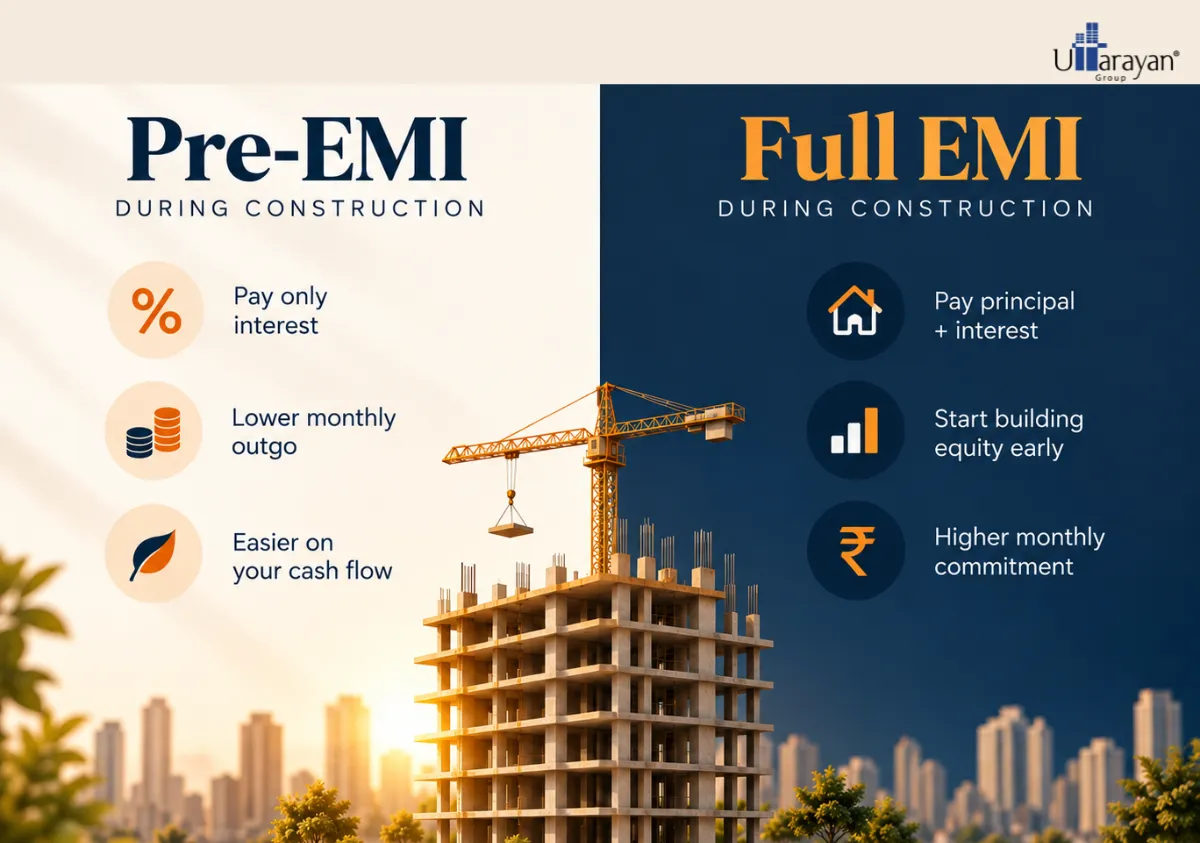
Short answer: Full EMI usually costs less over time. Pre-EMI keeps your monthly outgoings lower while the flat is being built.
With over 20 years of building homes in the North-East, we see this decision at almost every booking. Here is the pre-EMI vs full EMI math, in plain numbers.
What is the difference between pre-EMI vs full EMI?
Pre-EMI means paying only interest on the loan amount released so far. Full EMI means paying principal plus interest from the first disbursement.
- Pre-EMI: Interest-only. It rises as each construction-linked tranche is released.
- Full EMI: A fixed home loan EMI from day one. Part of every payment reduces principal, so the loan closes sooner.
Which costs less over time: pre-EMI or full EMI?
Full EMI, in most cases, because principal starts falling earlier.
Example: ₹50 lakh loan at 8.5% (illustrative), 20-year total tenure, five ₹10 lakh tranches over a 36-month build.
| Pre-EMI | Full EMI | |
|---|---|---|
| Monthly outgo during construction | ₹7,083 rising to ₹35,417 | ₹43,391 fixed |
| Paid in 36 months | ≈ ₹7.1 lakh | ≈ ₹15.6 lakh |
| EMI after possession | ≈ ₹46,415 | ₹43,391 |
| Total interest | ≈ ₹51.8 lakh | ≈ ₹30.8 lakh |
| Loan closes in | 20 years | ≈ 15.6 years |
- Full EMI saves roughly ₹21 lakh in interest.
- The trade-off: about ₹8.5 lakh more cash out during construction.
- If your lender counts tenure only after possession, pre-EMI costs even more.
What is the EMI activation date, and why does it matter?
It is the date your full principal-plus-interest EMI officially begins. With full EMI, it usually falls the month after your first disbursement. With pre-EMI, it follows final disbursement or possession.
- Find it in your sanction letter and loan agreement.
- Match it to the builder’s RERA-registered possession date.
- Ask what happens to your home loan EMI if possession is delayed.
When does pre-EMI still make sense?
When monthly cash flow matters more than total cost.
- You are paying rent while the flat is built.
- You plan to sell soon after possession.
- You can reliably invest the difference at returns above your loan rate (uncommon).

How are pre-EMI and full EMI taxed?
Both create “pre-construction interest,” claimable only after construction is complete.
- It is claimed in five equal yearly installments from the year of completion (Section 22, Income Tax Act 2025, earlier Section 24(b)).
- For a self-occupied home, it sits within the ₹2 lakh yearly interest cap under the old regime. It is not available under the new regime.
- Confirm your position with a chartered accountant.
What should Guwahati buyers plan for?
Budget for the full EMI, even if you choose pre-EMI. The flat rate in Guwahati runs roughly ₹4,500–₹7,000 per sq ft depending on locality, so an apartment for sale in Guwahati of 1,100 sq ft can cost ₹50–77 lakh.
- Compare home finance offers from two or three lenders.
- Ask each lender to show both repayment schedules side by side.
- Prefer RERA Assam-registered projects with clear possession timelines. Explore our RERA-registered projects Uttarayan Shreejoni I and Uttarayan Shreejoni II.
Conclusion
In the pre-EMI vs full EMI choice, pick full EMI if you can afford it. Pick pre-EMI if cash flow is tight or you plan to sell early.
Exploring an apartment for sale in Guwahati?
Talk to the Uttarayan Group team about payment plans and site visits.
Phone No : +91 98540 40005
FAQ’s
1. Is pre-EMI or full EMI better for first-time buyers?
Full EMI saves more interest if your budget allows. Pre-EMI suits first-time buyers who are also paying rent during construction.
2. Does pre-EMI reduce my loan principal?
No. Pre-EMI covers only interest on the amount disbursed, so your principal stays unchanged until full EMI begins.
3. When does my home loan EMI start on an under-construction flat?
Full EMI usually starts the month after your first disbursement. With pre-EMI, it starts on the EMI activation date, after final disbursement or possession. Confirm it in your sanction letter.
4. What happens to pre-EMI if possession is delayed?
You keep paying interest for longer, with no principal reduction. Choose RERA Assam-registered projects and ask the lender how delays affect your schedule.
5. Does the flat rate in Guwahati change which option is better?
Yes, because a higher flat rate means a bigger loan. That widens the gap between pre-EMI and full EMI, so run your own figures through the lender's calculator.

Ankit Baheti
DirectorAnkit Baheti is a real estate developer with over 10 years of experience in residential and warehousing development. A civil engineer by training, he specialised in Construction Management at the University of Illinois Urbana-Champaign. He leads Uttarayan, one of Assam’s leading real estate developers, delivering large-scale lifestyle and industrial projects. His writing offers clear, practical insights into real estate development and investment.
Related Post

Six Mile, Guwahati Vs Zoo Road: Which Ar [...]
If you're a young professional moving to Guwahati or already here and thinking of switching neighbou [...]
Flats In Adabari Guwahati: Price Guide & [...]
If you're genuinely looking for flats in Adabari, Guwahati, by now you already know the problem : ev [...]Looking for a dream home?
We can help you realise your dream of a new home.

0 Comments