
Get Support
+91 98540 40005

Sale Agreement Vs Sale Deed: What Every Guwahati Flat Buyer Must Understand
-
 By: Ankit Baheti
 - 6th July, 2026
- 0 Comments
- 154 Views
Key takeaways:
- Sale Agreement vs Sale Deed: What Every Guwahati Flat Buyer Must Understand
- What Is a Sale Agreement?
- What Is a Sale Deed?
- Sale Agreement vs Sale Deed: The Core Difference
- Agreement to Sell vs Sale Deed: Are They Really Different Documents?
- Why This Matters More in Guwahati
- Step-by-Step Process to Buy a Flat in Guwahati
- A Quick Real-World Example
- Final Thoughts
- FAQ’s
Last year, a friend of mine finally booked his dream flat in Zoo Road, Guwahati. He paid the token amount, signed a document with the builder, and told everyone he had "bought" the flat. Three months later, his loan got stuck — because the bank asked for a document he hadn't even heard of: the sale deed. That one mix-up between a sale agreement and a sale deed cost him weeks of delay and a fair bit of stress.
If you're planning to buy flat, Guwahati style — meaning through a builder, broker, or resale owner — this confusion is more common than you'd think. So let's settle it once and for all: sale agreement vs sale deed — what's the actual difference, and why does it matter so much when you're eyeing properties in Guwahati?
This sale agreement vs sale deed confusion isn't unique to Guwahati, but it hits local buyers harder because of how property registration and stamp duty work in Assam. Getting the sale agreement vs sale deed distinction right before you sign anything can save you weeks of stress later.
What Is a Sale Agreement?
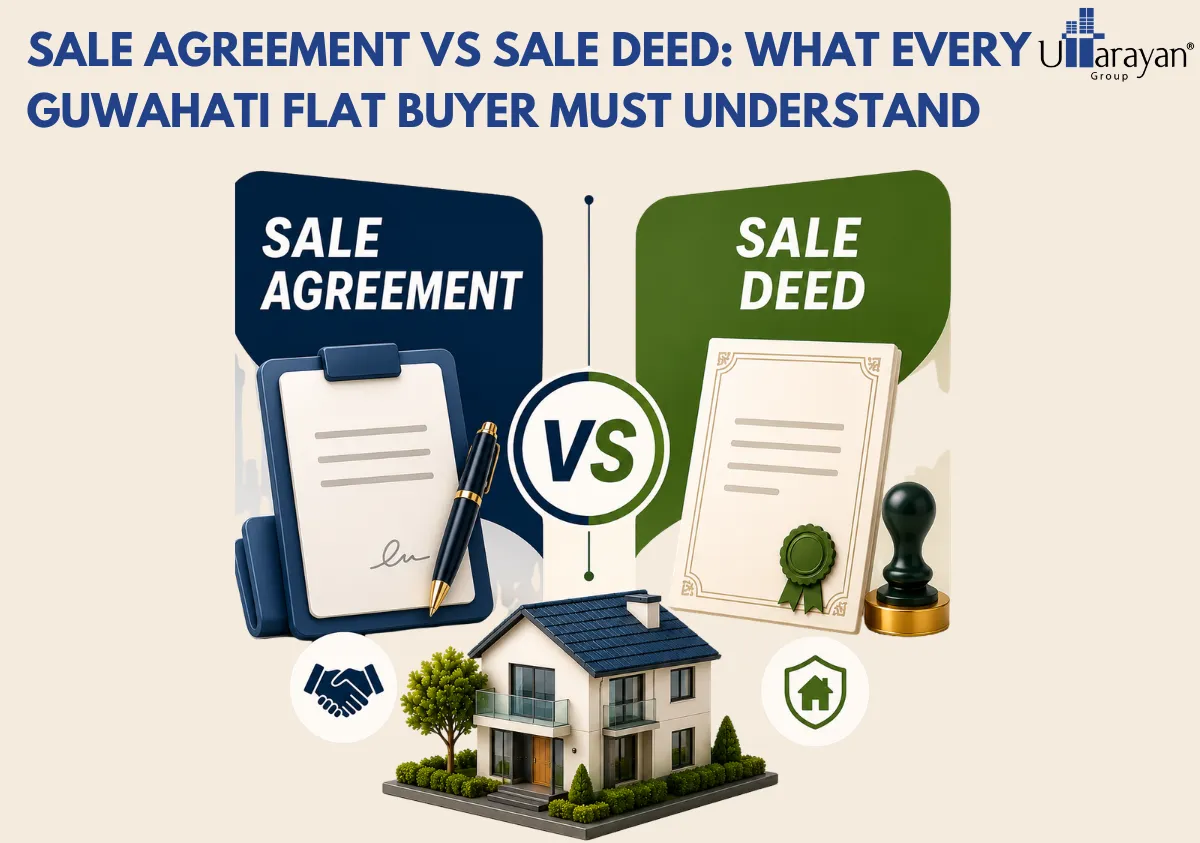
A sale agreement (also called an agreement to sell) is a promise. It's a written contract where the seller agrees to sell and the buyer agrees to buy a property, on terms both sides accept — price, payment schedule, possession date, and penalties for backing out. It does not transfer ownership. Whether you're looking at a house for sale in Guwahati or an under-construction flat, this is usually the first document you'll sign.
Think of it as a "we have a deal" document. Legally, it's enforceable — if either party breaks the terms, the other can go to court. But the property still belongs to the seller until the next step happens.
What Is a Sale Deed?
This is where the real transfer happens. What is a sale deed, in plain terms? It's the final, legally registered document that actually transfers ownership from seller to buyer. Once it's signed, stamped, and registered at the sub-registrar office Guwahati buyers are dealing with (usually based on the property's jurisdiction), the flat legally becomes yours.
Under Section 54 of the Transfer of Property Act, 1882, and the Registration Act, 1908, any immovable property worth more than ₹100 must be transferred through a registered sale deed. So no matter how detailed your agreement was, without a registered sale deed, you are not the legal owner.
Sale Agreement vs Sale Deed: The Core Difference
Here's the sale agreement vs sale deed comparison boiled down:
| Aspect | Sale Agreement | Sale Deed |
| Purpose | Promises a future sale | Executes the actual sale |
| Ownership transfer | No | Yes |
| Registration | Recommended, not always compulsory | Legally mandatory |
| Stage of transaction | Beginning | Final step |
| Legal remedy if broken | Sue for damages/specific performance | Ownership is already settled |
This is the crux of the sale agreement vs sale deed debate that trips up so many first-time buyers. People assume that once they've signed the agreement and paid the builder, they own the flat. They don't — not yet. Keeping the sale agreement vs sale deed table above handy can help you double-check exactly where you stand in the process at any given point.
Agreement to Sell vs Sale Deed: Are They Really Different Documents?
Some buyers ask this as if agreement to sell vs sale deed is a trick question — it isn't. "Agreement to sell" is simply another name for the sale agreement. So the agreement to sell vs sale deed comparison is exactly the same as sale agreement vs sale deed: one is a promise, the other is proof of ownership. Builders in Guwahati almost always use an agreement to sell first, especially for flats still under construction, followed by the sale deed once the project is complete and full payment is made.

Why This Matters More in Guwahati
Assam's stamp duty and registration costs are among the higher ones in the country — commonly cited around 6% stamp duty plus additional registration charges, depending on the buyer's gender and property value. Because these charges apply specifically at the sale deed registration stage, buyers scouting properties in Guwahati need to budget for this cost upfront, not after they've already paid the builder.
Here's a simple step-by-step way to think about it when you buy flat Guwahati properties:
- Shortlist and negotiate: whether it's a house for sale in Guwahati or a new project, finalize price and terms.
- Sign the sale agreement: This locks in the deal and payment schedule.
- Complete payments as per the agreed milestones.
- Verify documents: title, encumbrance certificate, RERA registration if applicable.
- Execute the sale deed at the sub-registrar office Guwahati authorities designate for that zone.
- Pay stamp duty and registration charges, then collect your registered sale deed: this is your real proof of ownership.

A Quick Real-World Example
Consider a buyer purchasing a 2BHK in Guwahati's Six Mile area. She signs a sale agreement with the builder and pays 20% as booking amount. For the next eight months, she is legally protected by that agreement — she can enforce the deal or claim damages if the builder backs out. But she isn't the owner yet. Only when construction finishes, the balance is paid, and the sale deed is registered does the flat legally become hers. This is exactly why understanding sale agreement vs sale deed isn't just legal trivia — it directly affects when you can apply for a home loan top-up, sell the property again, or use it as collateral.
Final Thoughts
The sale agreement vs sale deed distinction isn't just legal jargon — it's the difference between thinking you own a home and actually owning one. Whether you're comparing a house for sale in Guwahati, browsing properties in Guwahati online, or finalizing a deal with a builder, always remember: the agreement protects your interest during the process, but only the registered sale deed makes you the legal owner.
Before you sign anything, get a local property lawyer to review both documents. It's a small cost compared to the confusion my friend went through — all because he thought his sale agreement was the finish line, when it was only the starting point.
FAQ’s
1. Is a sale agreement legally binding?
Yes. Even without transferring ownership, a sale agreement is enforceable in court under the Indian Contract Act and the Specific Relief Act. This is one of the most searched questions around sale agreement vs sale deed, and the answer matters most when a builder delays possession.
2. Can I skip the sale agreement and go straight to a sale deed?
For ready-to-move properties in Guwahati, sometimes buyers do this. But for under-construction flats, a sale agreement is essential to protect your payments.
3. Where do I register the sale deed in Guwahati?
At the sub-registrar office Guwahati has jurisdiction over that property's location, this varies by zone, so confirm with your lawyer or the builder beforehand.
4. What documents should I check before signing either document?
Title deed, encumbrance certificate, RERA registration, occupancy certificate, and the seller's identity proof.

Ankit Baheti
DirectorAnkit Baheti is a real estate developer with over 10 years of experience in residential and warehousing development. A civil engineer by training, he specialised in Construction Management at the University of Illinois Urbana-Champaign. He leads Uttarayan, one of Assam’s leading real estate developers, delivering large-scale lifestyle and industrial projects. His writing offers clear, practical insights into real estate development and investment.
Related Post

Six Mile, Guwahati Vs Zoo Road: Which Ar [...]
If you're a young professional moving to Guwahati or already here and thinking of switching neighbou [...]
Flats In Adabari Guwahati: Price Guide & [...]
If you're genuinely looking for flats in Adabari, Guwahati, by now you already know the problem : ev [...]Looking for a dream home?
We can help you realise your dream of a new home.

0 Comments