
Get Support
+91 98540 40005

North Guwahati Property Prices: How The Saraighat Bridge Expansion Is Changing The Market
-
 By: Ankit Baheti
 - 6th July, 2026
- 0 Comments
- 141 Views
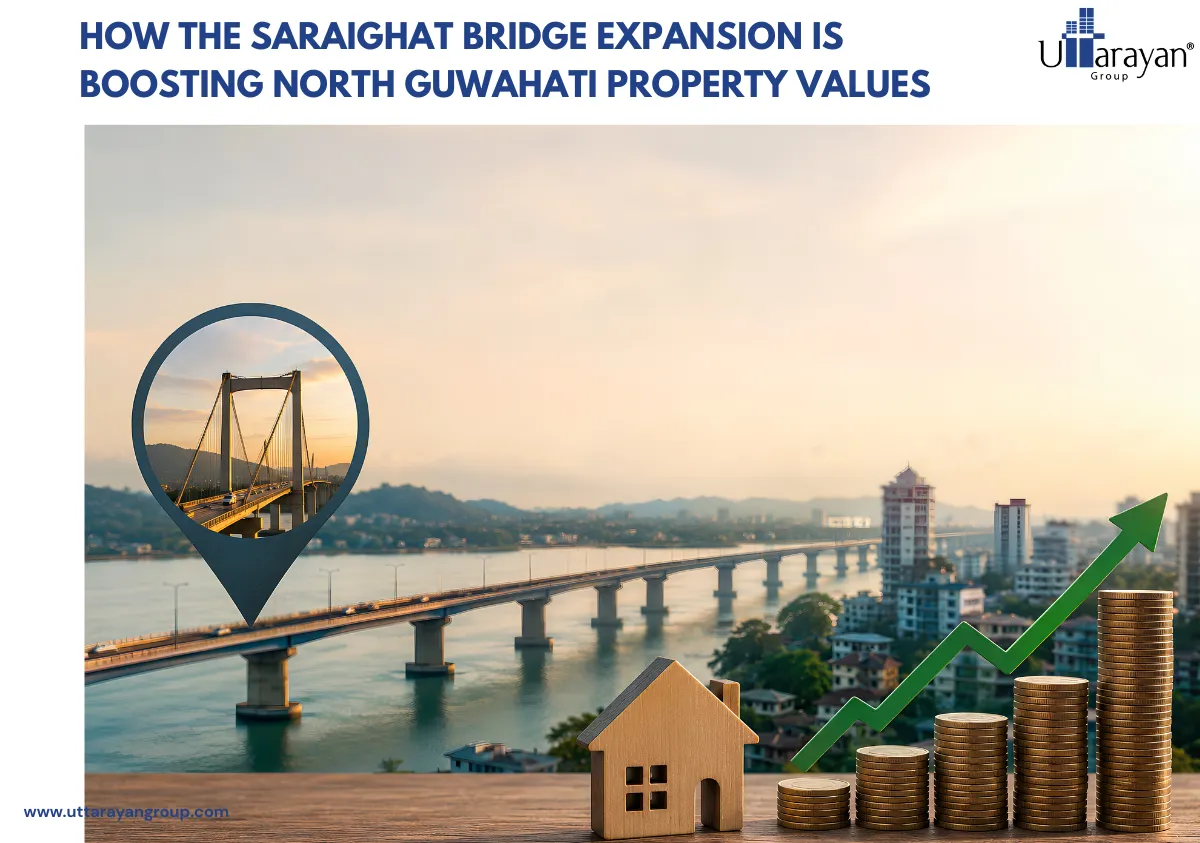
If you've been tracking property in Guwahati lately, you've probably noticed the same pattern I have. North Guwahati, once dismissed as "the other side of the river," is suddenly where the conversation is happening. More bridges across the Brahmaputra mean faster commutes, and faster commutes mean more buyers. Prices are climbing because of it.
Why North Guwahati Is Suddenly on Every Investor's Radar
For decades, North Guwahati sat on the wrong side of a bottleneck. Being "just across the river" meant crossing a slow, congested bridge the old Saraighat Bridge every single day. That one constraint kept prices low and development lagging far behind what the rest of the city was seeing.
It's part of a broader shift in Guwahati real estate, where growth corridors are moving further from the traditional core with each passing year.
That changed when the New Saraighat Bridge cut travel time significantly after opening in 2018. Now, even bigger shifts are underway: the Bharalumukh–Amingaon Bridge is currently under construction, and the Guwahati passenger ropeway has added another way to cross without touching a traffic jam. Because of these projects, North Guwahati is no longer a faraway suburb, it's turning into a working extension of the city itself.

How the Saraighat Bridge Expansion Is Fueling North Guwahati Real Estate Growth
The Saraighat Bridge is the single biggest reason North Guwahati real estate has moved from "cheap and overlooked" to "in demand." Before the second bridge opened, a 20-minute drive on paper could easily turn into 45 minutes in real traffic. That unpredictability kept buyers away, no matter how affordable the land was.
Once the Saraighat Bridge expansion eased that pressure, North Guwahati stopped being a compromise and started being a genuine option, for young families, first-time buyers, and investors who'd been priced out of the city center. Every new road project since has added to that momentum, and each one pulls this corner of the market a little closer to the mainstream.
North Guwahati Property Price Trends: What the Numbers Show
The price movement isn't just talk, it shows up in the data. Over the past three years, property prices in Dharapur have risen by roughly 26.2%, while Garchuk has climbed close to 25%. Zoom out further, and property prices in North Guwahati are up nearly 95% since 2021.
Even with that jump, prices here are still lower than the established parts of the city. Areas like Amingaon and Madanpur remain considerably more affordable than Pan Bazaar or Fancy Bazaar, which is exactly why the region keeps pulling in new buyers looking for value before prices catch up further.
North Guwahati vs. Central Guwahati: Where Should You Invest?
| Factor | North Guwahati | Central Guwahati |
| Average price /sq ft | Lower, still affordable | ₹5,000+ in prime areas |
| 3-year appreciation | 20–26% in developing areas | 5–8% in developed areas |
| Connectivity | Improving fast (new bridges, ropeway) | Already saturated |
| Land availability | More open plots, room to build | Limited, mostly resale |
| Investment stage | Early growth phase | Mature market |
Best Areas to Invest in North Guwahati Right Now
If you're deciding where in the region to put your money, these are the pockets worth watching:
- Dharapur: closest to the bridge corridor, and already showing the strongest appreciation.
- Garchuk: steady growth, with more open land still available.
- Amingaon: the most affordable entry point, with the biggest room to grow.
- Sangsari: quieter for now, but picking up interest as nearby areas fill in.

Is North Guwahati Worth It If You're Looking for Property in Guwahati?
If you're specifically hunting for property in Guwahati and don't want to overpay for a "finished" neighborhood, North Guwahati is worth serious consideration. You're buying into a market that's still catching up to its own potential, not one that's already priced in every improvement.
That said, property in Guwahati isn't a one-size-fits-all decision. If your priority is being close to established schools, hospitals, and offices today, central Guwahati still wins. If you can be patient and want more upside, North Guwahati is where that upside currently sits.
Conclusion
North Guwahati isn't a hidden gem anymore plenty of buyers have already noticed. But compared to how central Guwahati real estate has already priced in its growth, North Guwahati still looks like a market catching up to its own potential. If you're weighing your options for property in Guwahati, this is one corner of the city where the infrastructure story is still being written, and where getting in early has historically paid off.
FAQ’s
1. Is North Guwahati a good area for property investment in 2026?
Yes. Prices in North Guwahati are still lower than central Guwahati, and new bridge construction is making the area far more accessible. As connectivity keeps improving, property values are expected to keep climbing.
2. How is the Saraighat Bridge connected to rising property prices in North Guwahati?
The New Saraighat Bridge (2018) and the upcoming Bharalumukh–Amingaon Bridge have both cut travel time between North Guwahati and the city center. Easier commutes have made the area far more livable and far more attractive to buyers.
3. Which areas in North Guwahati are appreciating fastest?
Dharapur, Garchuk, and Amingaon currently show the strongest price growth, largely thanks to their proximity to the new road and bridge infrastructure.
4. Is North Guwahati cheaper than the rest of Guwahati?
Yes. Central Guwahati often runs above ₹5,000 per sq. ft., while many pockets of North Guwahati remain considerably more affordable even as demand steadily increases.
5. How much can property prices in North Guwahati rise once the Bharalumukh–Amingaon Bridge is complete?
There's no official figure yet, but based on how prices moved after the New Saraighat Bridge opened in 2018, similar or greater appreciation is expected once the new bridge reduces travel time further.

Ankit Baheti
DirectorAnkit Baheti is a real estate developer with over 10 years of experience in residential and warehousing development. A civil engineer by training, he specialised in Construction Management at the University of Illinois Urbana-Champaign. He leads Uttarayan, one of Assam’s leading real estate developers, delivering large-scale lifestyle and industrial projects. His writing offers clear, practical insights into real estate development and investment.
Related Post
Six Mile, Guwahati Vs Zoo Road: Which Ar [...]
If you're a young professional moving to Guwahati or already here and thinking of switching neighbou [...]
Flats In Adabari Guwahati: Price Guide & [...]
If you're genuinely looking for flats in Adabari, Guwahati, by now you already know the problem : ev [...]Looking for a dream home?
We can help you realise your dream of a new home.

0 Comments