
Get Support
+91 98540 40005

Property Appreciation In Guwahati: Growth Trends In 5 Years
-
 By: Ankit Baheti
 - 13th May, 2026
- 0 Comments
- 1350 Views
Key takeaways:
- Guwahati properties appreciated 35–40% on average between 2020 and 2026
- Kahilipara grew the most — up 50.7% in 5 years
- Dharapur, Garchuk, and Khanapara are the fastest-moving zones in the last 3 years
- Growth was driven by NH-27 expansion, RERA, AIIMS Guwahati, and post-COVID migration
- New launch flats command a ~17% premium over resale in Guwahati
- Best zones to watch for 2026–2030: Metro corridors (Jalukbari, Khanapara), North Guwahati, and early-stage zones like Tetelia
- North Guwahati is the contrarian bet — underperforming now, high potential if connectivity improves
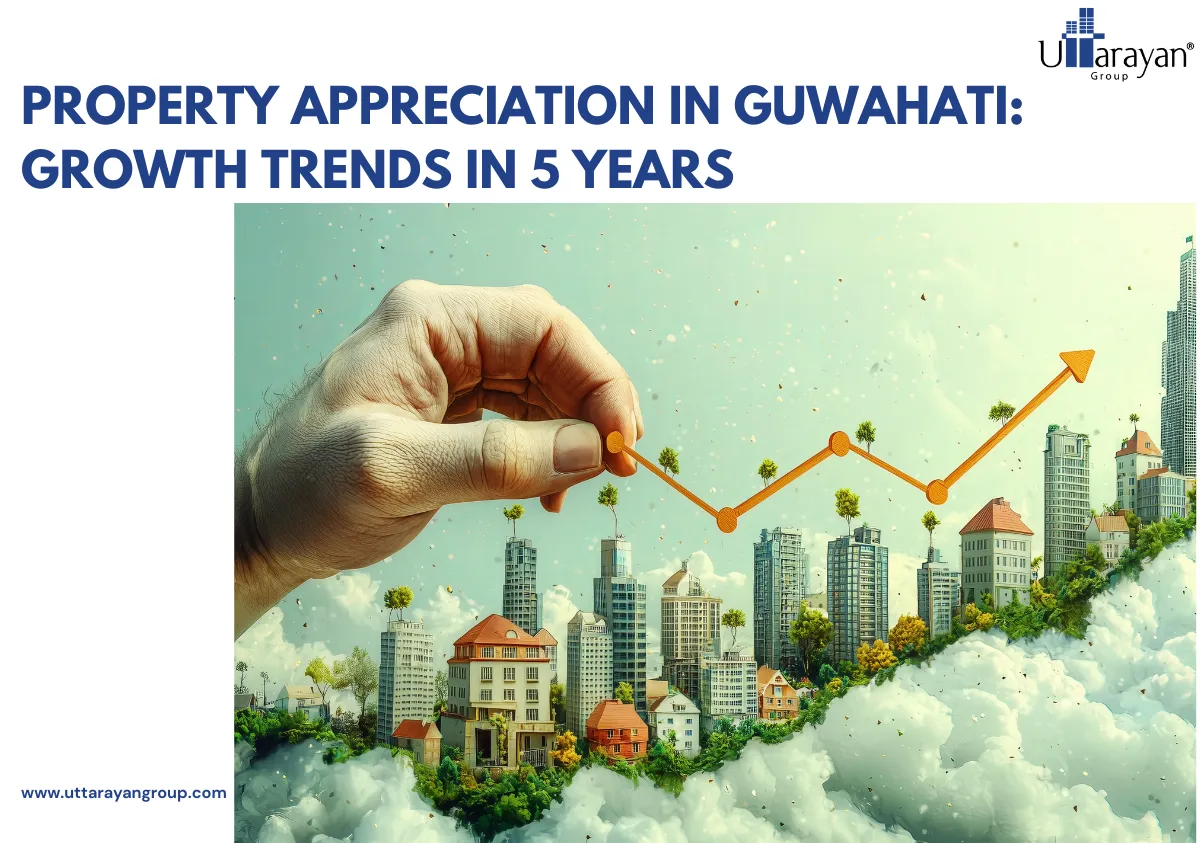
If you bought a flat in Kahilipara five years ago, your property would be worth around 50% more today. And if you had invested near Dharapur when the NH-27 widening work had just started, then today you are looking at 26% growth in just three years. These are not just data, but the real story of Guwahati’s real estate market. Today, property appreciation in Guwahati is a must to follow and be a part of.
But averages won’t give you the whole story. Where you buy matters as much when you are buying a property. This guide will break down the numbers for you, locality by locality, so that you know what’s happened and what might come next.
Guwahati’s 5-year property appreciation at a glance
Here are some of the numbers that you definitely need to know before you immerse yourself in this property guide:
- The average residential appreciation in Guwahati between 2020 and Q1 of 2026 sits at about 35–40%.
- Kahilipara has been leading with an estimated +50.7% over 5 years — from INR 4,200/sq. ft to INR 6,328/sq. ft.
- The airport corridor (Dharapur, Azara) and the South Guwahati belt (Garchuk, Lokhra) have been the fastest-moving zones in the last three years.
- Newly launched properties in Guwahati are currently enjoying a ~16.84% premium over resale.
- RERA-registered projects with modern amenities are actively attracting residents and investors and taking the average prices upward.
- Even though North Guwahati has been lagging in comparison, but that gap may close soon.
Locality-wise real estate appreciation table (2020–Q1 2026)
| Locality | Est. 2020 Price/sq. ft (INR)* | Q1 2026 Price/sq. ft (INR) | 5-year appreciation | Market tier |
| Kahilipara | 4,200 (est.) | 6,328~ | +50.7% | Premium Central |
| Dharapur | 3,100 (est.) | 3,913~ | +26.2% (3yr data) | Airport Corridor |
| Garchuk | 3,400 (est.) | 4,250~ | +25.0% (3yr data) | South Growth Belt |
| Khanapara | 3,600 (est.) | 4,335~ | +20.4% (3yr data) | Gateway Zone |
| GS Road | 4,800 (est.) | 6,200~ | +29% | Premium Central |
| Six Mile / Jayanagar | 3,200 (est.) | 4,000~ | +25% | Employment Hub |
| Beltola | 3,500 (est.) | 4,400~ | +26% | South Belt |
| Azara | 2,900 (est.) | 3,600~ | +24% | Airport Corridor |
| Jalukbari | 3,000 (est.) | 3,700~ | +23% | West Corridor |
| Lokhra | 2,700 (est.) | 3,300~ | +22% | South Growth Belt |
| Noonmati | 2,800 (est.) | 3,300~ | +18% | North Fringe |
| Lal Ganesh | 3,000 (est.) | 3,500~ | +17% | Central North |
Source: 99acres March 2026, Magicbricks, RERA registry cross-reference.
*Important note: 2020 prices for localities marked (est.) are back-calculated estimates from available 3-year data. Treat them as directional indicators, not exact historical records.
Top 5 locality champions: Which localities grew fastest?
#1 — Kahilipara: INR 4,200 to INR 6,328/sq. ft (+50.7% over 5 years)
One of the best localities currently to buy flats in Guwahati is Kahilipara. And it has earned this position for quite a few reasons. The locality is in close proximity to Dispur (the state capital) and has direct access to the GS Road commercial. Both these reasons have helped it rise to premium residential pricing.
Today, Kahilipara is one of Guwahati’s highest per-sq. ft zones. But this locality isn’t going to be the best pick for those looking for an affordable entry. However, the real estate growth is good for those looking for a steady long-term appreciation.
#2 — Dharapur: +26.2% in just 3 years (2023–2026)
Dharapur is winning majorly by being seen as the airport corridor locality. The NH-27 six-lane expansion has cut travel times and made properties here genuinely accessible to the potential residents. And the strong NRI buyer demand for this region has also helped the locality get better property appreciation.
The 3-year number is what’s publicly verifiable. Watch this zone closely for the next cycle too.

#3 — Garchuk: +25.0% in 3 years (2023–2026)
Garchuk’s growth story is a little different from Dharapur’s because it has been driven by new quality supply of residential projects as well as by infrastructure. As soon as premium RERA-registered projects entered this zone, it changed what buyers expected.
Additionally, improved connectivity to GS Road and Beltola Bazar has also helped. With a strong demand from family buyers looking for an upgradation, Garchuk has become a preferred zone for modern apartments in a quieter but well-connected setting.
Read me: Ultimate Guide: How to buy a flat in Garchuk, Guwahati
#4 — Khanapara: +20.4% in 3 Years
Khanapara is another locality that has been performing well in Guwahati. Flats in Guwahati in this region sits between South Guwahati and the airport corridor, giving it a strategic advantage. This positioning has made it attractive for IT and commercial tenants, buyers who need regular airport access, and those who want a little of both.
IIT Guwahati has also helped attract faculty and researchers for quality housing in this area. Expect this zone’s story to develop further as commercial activity grows.
#5 — Six Mile / Jayanagar: Steady, employment-driven growth
Six Mile and Jayanagar might not have high-end numbers like Dharapur or Garchuk, but they don’t need these numbers to win at the moment. Close proximity to the IT park and consistent government office demand means that professional tenant pool demand will always be there.
Appreciation in both these localities have been steady rather than sharp, and this also means that there is less downside risk, too. This is a good zone for investors who value consistency over peaks.
Read me: Property Guide: Six Mile & Jayanagar – Guwahati’s Top Rentals
What actually drove the property appreciation? Guwahati’s 5 biggest growth catalysts
Understanding why the city’s prices moved upwards the way they did is what will actually help you make better decisions going forward.
1. Infrastructure development: The primary catalyst
Without doubt, infrastructural development is one of the main reasons for real estate Guwahati to reach the position it enjoys today. And among all, the NH-27 six-lane expansion is surely at the top. It didn’t just reduce the travel time, but also changed these peripheral zones from being “far from everything” to “well-connected.”
Add to this the Metro Rail and improving North-South ring road connectivity, and you will start to see how infrastructure is reshaping the city’s value map zone by zone.
Read me: Flats Near Guwahati Airport: Why Dharapur Is the Smart Buyer’s Choice
2. RERA implementation
Since 2018, as soon as RERA made an entry, the trust towards real estate developers in Guwahati went up. Guwahati’s pre-RERA market had a serious buyer trust problem thanks to delivery delays and confusion about pricing. RERA changed that structural reality and builders now need to be accountable and timelines are trackable.
The result? New buyers who wouldn’t have touched a developer project by a real estate company in Guwahati in 2015 were comfortable buying in 2020. This is why 2018–2026 represents a distinctly different price growth trend compared to what came before.
3. AIIMS Guwahati and the healthcare economy
The launch of AIIMS Guwahati’s was an important factor for driving residential demand. Medical professionals, hospital staff, and researchers, working at the hospital needed homes nearby and this directly impacted demand. Plus, families of patients requiring extended stays need quality housing near the facility as well and that’s a great factor for driving rental demand. Together, AIIMS helped the city’s property prices grow.
4. Post-COVID urban migration
Between 2020 and 2022, something happened: Tier-2 cities like Guwahati became genuinely attractive to people who had previously moved to metros for work. Buyers returned to Assam with metropolitan-level budgets and expectations and that helped prices move up across the city.
Flat price in Guwahati has since then moved steadily and property appreciation has led to the entry of more real estate developers in Guwahati and projects.
5. The new launch premium factor
New RERA-registered projects from real estate company in Guwahati attract roughly a 16.84% premium over comparable resale flats in Guwahati. Factors like modern amenities, builder guarantees, flexible payment plans, and verified legal status helped the price become premium.
Homebuyers were ready to buy flats in Guwahati in this premium category for the features they got in return. And when a high-quality project launches in a zone, it doesn’t just add units, but also raises the entire zone’s price floor.
Explore 3 BHK flat in Guwahati
Appreciation by zone type: Patterns every investor should know
1. Premium central zones (Kahilipara, GS Road) — Price-led growth
These zones were already expensive in 2020, and with the passing years they have become more expensive. There isn’t really much new land remaining to develop in these zones and this scarcity is helping drive premium prices in the established central locations.
Investor angle: It is ideal for capital preservation and steady long-term appreciation but not the right zone if you are looking for huge returns on a relatively small entry price.
2. Airport corridor (Dharapur, Azara) — Infrastructure-led growth
This zone has shown a classic growth zone pattern: lower entry price, infrastructure development, rapid property appreciation. This combination has helped generate the highest absolute returns because you are capturing both the entry price advantage and the infrastructure uplift.
Investor angle: Understand if the prices have already peaked as it should have or still appreciating before moving in. For Dharapur, the NH-27 upgrade is largely done, but NRI demand remains strong.

3. South Guwahati growth belt (Garchuk, Lokhra) — Project supply-led appreciation
This is a market maturation story. When quality RERA-registered projects enter a zone, they pull buyers who previously wouldn’t have considered it. And this has helped (and is still helping) the demand rise in the entire zone’s value.
Investor angle: The arrival of projects like The Majesty created a quality ceiling for the rest of the real estate Guwahati market
4. North Guwahati (Noonmati, Maligaon) — Below-average growth so far
It is true that there hasn’t been much infrastructural growth in North Guwahati, but this could potentially be the right time before the gap closes. The 5-year performance has remained below the city average but this may be the most interesting bet for patient investors.
Investor angle: Once the cross-Brahmaputra connectivity improves, the gap between North and South could close quickly, and early investors would capture the full cycle.
Read me: Investing in Pre-Launch Projects in Guwahati: Opportunity vs Risk
Which zones are expected to appreciate most in 2026–2030?
Based on the market research, property appreciation trends, and demand from potential buyers, three types of zones are going to stand out in the next five years.
According to Ankit Baheti, Director of Uttarayan Group and recipient of the CREDAI Best Residential Project Award 2025, “the next four years will be defined by infrastructure-led appreciation in Metro-adjacent zones, with emerging peripheral localities offering the highest upside for patient investors.”
1. Metro-adjacent zones: Jalukbari, Khanapara, Dispur
Areas with confirmed metro station zones are going to be the most straightforward forward-looking play for real estate appreciation. Pre-Metro prices are still relatively accessible in some of these areas, but once the metro connectivity is operational, the infrastructure premium will be priced in. And buyers who entered early will get to enjoy that appreciation in their holdings.
Delhi, Bengaluru, and Pune have all shown the same pattern and we have seen metro corridors consistently outperform the city average.
2. North Guwahati: The long-term bet
If cross-Brahmaputra connectivity improves through bridge upgrades, metro extension, or improved ferry infrastructure then there will be no stopping for North Guwahati’s real estate growth. Today’s 12–15% property appreciation in this zone could look very different five years from now.
Yes, the risk is higher, but so will be the potential reward.
3. Emerging peripheral zones: Tetelia, Hengerabari
Today, these zones are where Garchuk and Dharapur were once in 2018–2020. They are at their early stage with relatively low prices, and as there are early signs of infrastructure interest, they could be the next big thing for properties in Guwahati.
Again, true that they carry more risk because not every peripheral zone gets the catalyst it needs. But for investors with a 5–7-year horizon and appetite for that risk, the potential upside is higher than anything already established.
Explore flat price in Guwahati in other peripheral zones
Using appreciation data to make a buy or hold decision
This property guide, up until now has helped you understand the numbers and the reasons behind property appreciation. But do you actually use them?
Let’s understand this in a simpler way. For instance, if your zone has appreciated 25%+ in 3 years, then there are two scenarios that could be:
Thinking of entering now? The key question you need to ask (and understand) is whether the infrastructure catalyst has been completed or is still ongoing. If it’s complete, then the price may already reflect the full benefit and you are entering late. But, if the catalyst is still in progress (metro under construction or a new road partially complete), then there’s still a good chance for appreciation ahead.
Already own in a high-appreciation zone? At Guwahati’s current rental yields of 3.5–4%, holding onto your property will remain financially rational unless you can use that capital elsewhere at a higher return flat in Guwahati or another Tier-2 city. You need to understand here that the decision to hold or sell shouldn’t be just about the asset, but instead about opportunity cost.
See our full guide on Property Holding Period in Guwahati
To be honest, property appreciation data will give you context, but not certainty. However, it will definitely help you narrow down your decisions to the zones and zone-types that have structural reasons to perform.
Explore properties in Guwahati's highest-appreciation zones
FAQS
1. Which area in Guwahati has the highest property appreciation?
Kahilipara leads Guwahati's five-year appreciation with an estimated 50.7% price increase between 2020 and 2026 (INR 4,200 to INR 6,328/sqft). Among three-year appreciation leaders, Dharapur recorded 26.2%, Garchuk 25.0%, and Khanapara 20.4% between 2023 and Q1 2026. Airport-adjacent and premium central zones consistently lead appreciation due to infrastructure investment and scarcity of new supply at the upper price point.
2. What were property prices in Guwahati 5 years ago?
In 2020-2021, Guwahati's residential property prices ranged from approximately INR 3,200-4,500 per square foot in established localities. Kahilipara was around ₹4,200/sq. ft; Garchuk and Dharapur were in the INR 3,800-4,200 range; and affordable zones like Azara and Jalukbari were INR 3,000-3,500/sq. ft. By Q1 2026, prices across all zones have advanced significantly, with top localities now at INR 5,200-6,328/sq. ft.
3. Is Guwahati real estate still worth buying after 5 years of appreciation?
Yes, for most buyer profiles. While Guwahati's top zones have appreciated 20-50% since 2020, the absolute prices remain 40-60% below comparable Tier-2 cities like Pune or Hyderabad. Infrastructure triggers like Metro Rail remain incomplete — meaning the appreciation cycle is mid-stage, not mature. Buyers entering in 2026 in Metro-adjacent and airport-corridor zones are still capturing meaningful upside, particularly if holding for 5+ years.
4. How does Guwahati's appreciation compare to other Tier-2 cities in India?
Guwahati's top zone appreciation of 25-26% over three years is competitive with Tier-2 peers like Coimbatore (+20%), Nashik (+18%), and Lucknow (+22%) over comparable periods. However, Guwahati's absolute price base remains significantly lower — making its appreciation translate into larger percentage gains from a lower entry point. This combination of lower entry + comparable percentage growth + NE India first-mover advantage makes Guwahati compelling relative to established Tier-2 markets.
5. What is the expected property appreciation in Guwahati in the next 5 years?
Based on infrastructure pipeline — Guwahati Metro Rail completion, airport expansion, AIIMS cluster maturation, and NH connectivity improvement — analysts expect continued above-average appreciation in Metro-adjacent zones (Jalukbari, Khanapara), airport corridor (Dharapur, Azara), and premium central zones (GS Road, Kahilipara). North Guwahati represents the highest-risk, highest-potential play depending on connectivity improvements. Emerging peripheral zones like Tetelia may see the fastest percentage gains from a low base.

Ankit Baheti
DirectorAnkit Baheti is a real estate developer with over 10 years of experience in residential and warehousing development. A civil engineer by training, he specialised in Construction Management at the University of Illinois Urbana-Champaign. He leads Uttarayan, one of Assam’s leading real estate developers, delivering large-scale lifestyle and industrial projects. His writing offers clear, practical insights into real estate development and investment.
Related Post
Six Mile, Guwahati Vs Zoo Road: Which Ar [...]
If you're a young professional moving to Guwahati or already here and thinking of switching neighbou [...]
Flats In Adabari Guwahati: Price Guide & [...]
If you're genuinely looking for flats in Adabari, Guwahati, by now you already know the problem : ev [...]Looking for a dream home?
We can help you realise your dream of a new home.

0 Comments